Understanding the Importance of Music in the Development of Children
Music and Numbers
Our intelligence is measured in different ways. A lot of studies have been conducted about the intelligence of humans and whether or not music can actually raise our I.Q.
Studies have uncovered that, if children are exposed to classical music from an early age, it can help build their neural pathways.
The musical and mathematical relationship in the brain
Music fires up all parts of the brain, and will therefore help with learning mathematical concepts and help children internalise these, as the same neural pathways are developed and strengthened whilst completing both tasks. Both the same areas of the brain are used for completing complex spatial-reasoning tasks, so it only makes sense to develop these areas with as much input as you can to grow the neural connections. Music is ideally suited to do this.
The left side of the brain is activated in the same area that is involved in analytical and mathematical thinking. It lights up when you learn to read music, understand notations and follow the sequence of notes.
The right side of the brain is activated when you hear melodies with a variety of pitch and timbre.
How can you use the power of music to help mathematical development with children in your centre?
There are a lot of musical activities you can do with kids, no matter their lifestage, but the earlier they are exposed to the world of music, the better! Let's look at the early stages.
Babies enjoy being sung to, so you could easily have lots of songs playing in the baby room and you can sing to the children. There are plenty of opportunities to do so, such as at nappy-changing time.
Choosing songs wisely will help. You could have mathematical songs, number songs and timetable songs – anything, really. Children will absorb and remember what they hear over and over again.
Babies are refining their ability to listen to different sounds, so you could sing the same information at different pitches. They especially love being sung to whilst being rocked, as both sensory outputs have rhythm.
Babies especially love bouncing, and will start to respond to music that way. All you have to do is choose songs that have numbers or patterns. As we all know, the ability to work with patterns is a huge part of being able to work mathematically, since mathematics is all about patterns.
Toddlers love to create made-up songs, so after having learnt to count to five or ten you challenge them to make up a song.
They also enjoy voice-inflection games, so learning to count using different beats and pitches is a perfect way to learn. Sing high, low, softly, fast, high/fast, softly/fast … you get the idea, right?
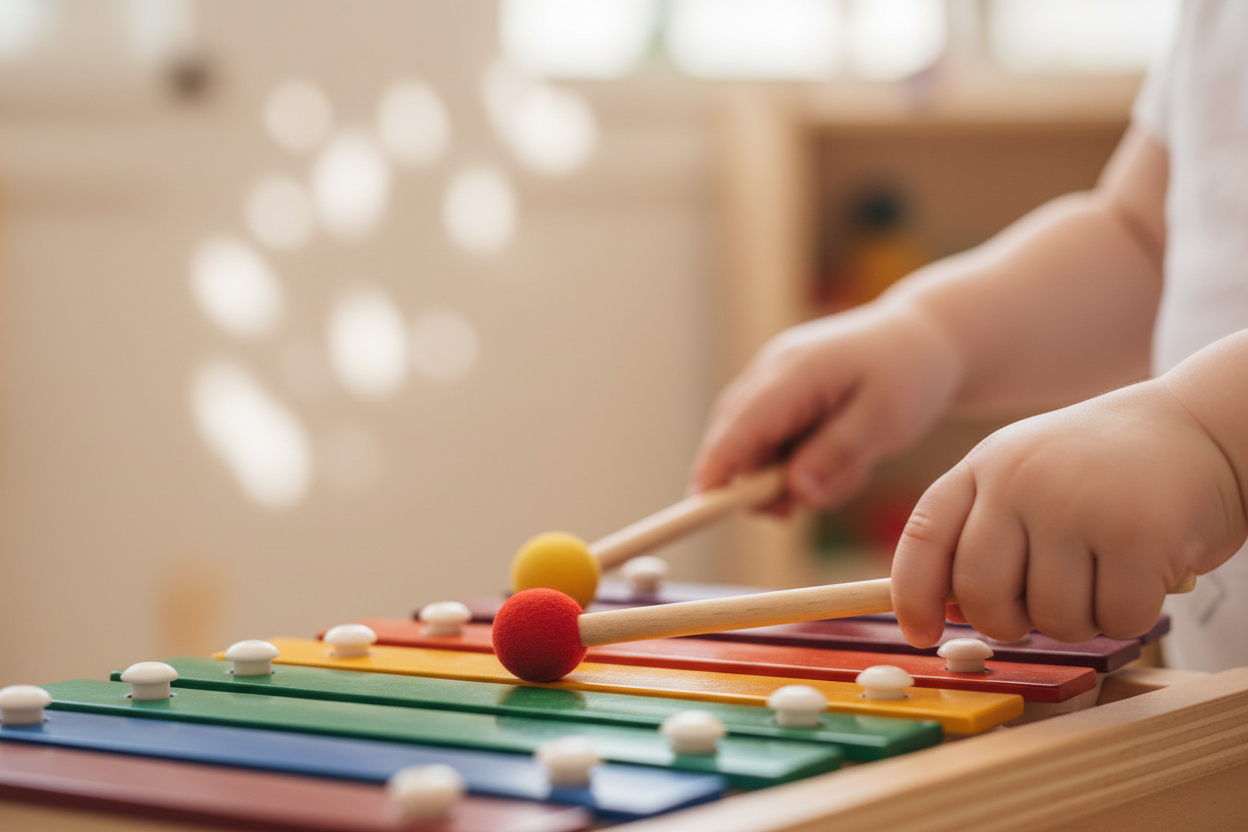
Toddlers love repetition, so don't think that you will be boring if you do the same song a hundred times. They are also very curious about musical instruments, so this is the perfect opportunity for you to use all of these and perform musical activities with them. You could strike your triangle every time you count to establish one-on-one correspondence, for example.
You could sit in a circle and have children each hold a different instrument and count on, so the first person strikes or taps their instrument and counts 'one', the next person does so and counts 'two', and so forth. You may need to do it lots of times, but it will eventually come together.
Now, the interesting part is that you do not want the activities to be successful at first. The harder the challenge, the more thinking is happening, and the more connections are growing in the brain, so music and mathematics are perfectly paired to develop the brain.
Toddlers love to dance, so lots of songs and dances that develop mathematical knowledge – such as counting or spatial awareness – are perfect. One that comes to mind would be 'The Hokey Pokey' for left, right, in and out distinction.
Toddlers love to be physically involved in a song, so songs with movements that refer back to musical concepts are perfect for this.